Advertisement
Advertisement
May/June 2026
The Financial Landscape of Renal Denervation
How reimbursement and evolving coverage policies are defining access to renal denervation.
By Catherine Vanchiere, MD, MA; Tayyab Shah, MD; Maria Bonanni, CRNP; Debbie L. Cohen, MD; Jay S. Giri, MD, MPH; and Brian Fulton, MD
Hypertension (HTN) impacts millions of Americans, driving the incidence of major sequelae such as stroke, myocardial infarction, and renal failure and accounting for an estimate of > $200 billion of health care spending annually.1 Resistant HTN, defined as blood pressure that is uncontrolled despite three or more antihypertensive medications of different classes, is not only a prevalent condition (affecting 8.5% to 20% of hypertensive American adults) but also one that is highly costly.2
Renal denervation (RDN) can address this condition where medication optimization fails. RDN is a percutaneous, catheter-based procedure in which ultrasound (Paradise system, Recor Medical) or radiofrequency (Symplicity Spyral system, Medtronic) is used to ablate the sympathetic nerves present in the adventitia of the renal arteries.3,4 This procedure effectively reduces blood pressure for patients with resistant HTN, which in turn may decrease major adverse cardiovascular events, including stroke and myocardial infarction.5-10
Despite the promising clinical impact of RDN, the current financial landscape of this procedure, although evolving, remains operationally complex, with access to this procedure contingent on alignment across multiple key stakeholders. This article describes the current financial framework within which RDN sits, with an eye toward future developments that will serve to increase access to the procedure for many who stand to benefit.
FDA APPROVAL
The first step to bringing RDN, or any new or investigational technology, to patients in the United States is approval by the FDA. Both the Symplicity Spyral and Paradise systems were approved for commercial use by the FDA in November 2023. The language of the FDA in a device’s instructions for use (IFU) provides initial guidance on the applicable patient population. This starting group is ultimately narrowed significantly to a much smaller pool of individuals for whom the procedure is covered by health insurance. The IFU for both of these RDN devices states, “[RDN] is indicated to reduce blood pressure as an adjunctive treatment in patients with [HTN] in whom lifestyle modifications and antihypertensive medications do not adequately control blood pressure.”3,4 This definition of the patient population is broad by design, permitting use of the device for studying safety and efficacy, as well as providing flexibility to treat a large number of patients.
NATIONAL COVERAGE DETERMINATION
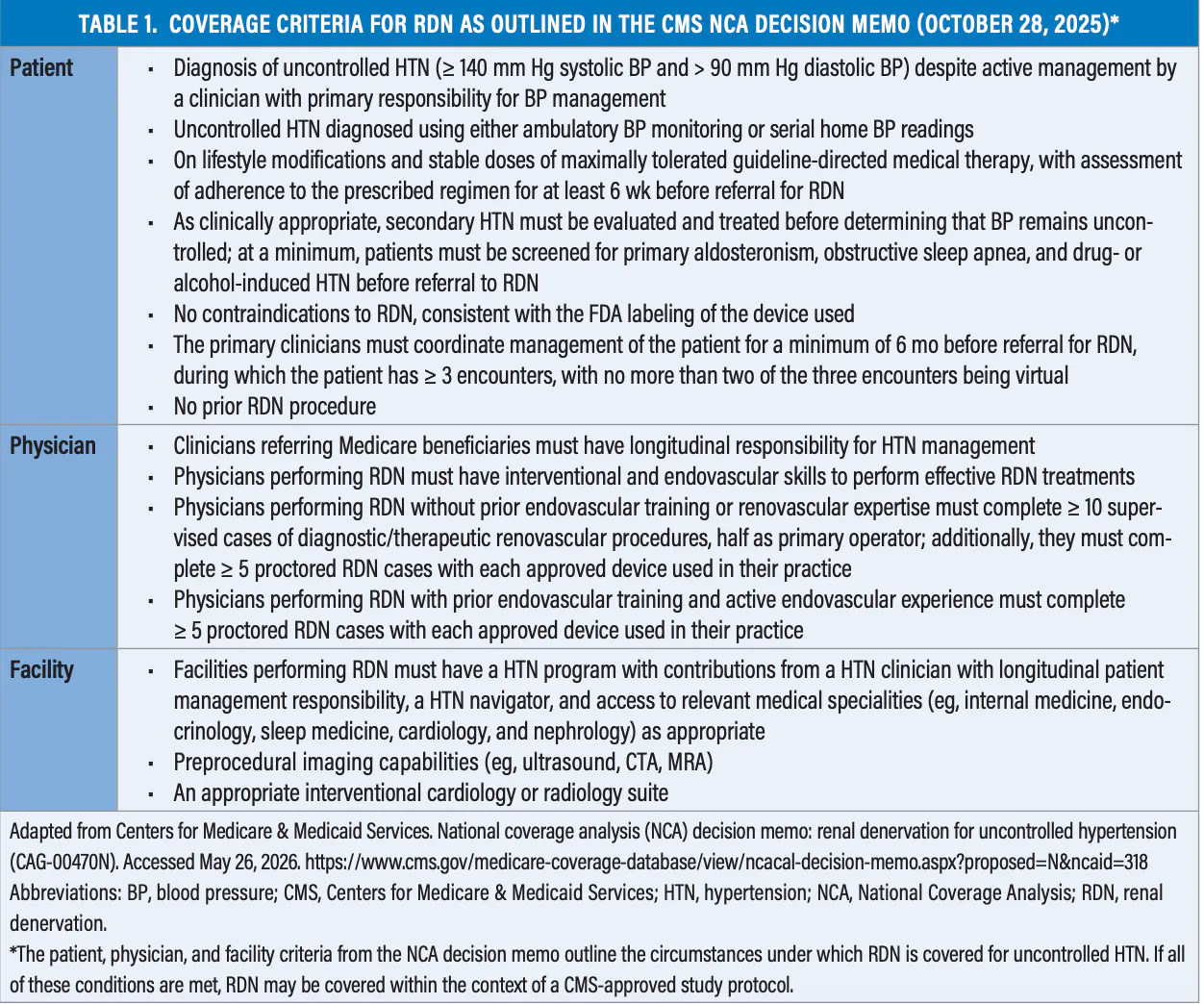
It is important to note that while FDA approval is a critical step, it does not impact decisions regarding insurance coverage and payment for the procedure. After the RDN devices were approved by FDA, the Centers for Medicare & Medicaid Services (CMS) opened a National Coverage Analysis in January 2025, which ultimately resulted in a National Coverage Determination (NCD) in October 2025, covering the procedure under Coverage With Evidence Development (CED) for patients, physicians, and facilities meeting a total of 14 defined criteria (Table 1).11 This conditional coverage pathway requires not only that these criteria are met but also that the procedure occurs within the context of a CMS-approved study or registry.11 As new data emerge, CMS may remove the study requirement when the evidence is believed to support full coverage, but this timeline is variable, often aligning with interim or final analyses from registries or trials. The NCD is critical because it sets a standard that is often the foundation of coverage decisions for commercial payers as well. However, there remains significant variability in reimbursement across insurers, which may lead to disparities in patient access to procedures like RDN.
Of note, the timeline from FDA approval to CMS NCD was approximately 2 years, which is quite fast compared to other catheter-based devices that have recently come to market. This relative speed was likely driven by mature randomized, sham-controlled data, a massive unmet need due to the high prevalence of resistant HTN, low procedural risk, and the ability to use CED to bridge remaining evidence gaps.
Despite the quick turnaround from FDA approval to CMS NCD, RDN still faces significant hurdles on the path to accessibility for patients. Many private insurers consider RDN investigational and thus do not provide coverage for the procedure, a decision that is reinforced by the CMS CED status rather than full coverage.12-14 This means that many patients who may benefit from RDN remain unable to access the procedure at this time, especially younger patients with uncontrolled HTN who may not yet qualify for Medicare. Of note, this younger population was captured in the clinical trials for RDN, with the mean age of patients in the early 50s to early 60s, meaning that those shown to benefit are also those who currently lack coverage.5-10 This problem may persist for multiple years while CMS evaluates new evidence to consider full coverage and private insurers broaden their coverage of RDN to include this key patient segment.
BILLING AND REIMBURSEMENT
For patients who are covered to undergo RDN, there remains the question of reimbursement for the procedure both to the physician performing the procedure (professional reimbursement) as well as to the hospital (facility reimbursement). The process to define professional reimbursement for new technologies is complex and driven by the American Medical Association (AMA), which is responsible for assigning CPT billing codes. CPT category I codes, which are permanent standard codes for an established procedure/service, have assigned relative value units (RVUs) and are paid under the Medicare Physician Fee Schedule. Currently, RDN is assigned a temporary category III CPT code,
which is used for emerging or investigational therapies, primarily to record utilization patterns as evidence evolves. Category III CPT codes are not assigned RVUs and do not have standardized national payment systems, although crosswalks have been used to map to an analogous CPT I code in order to estimate RVUs and allow physician payment. For instance, RDN codes (CPT 0338T [unilateral] and CPT 0339T [bilateral]) have most commonly been crosswalked to CPT 37236 (transcatheter placement of intravascular stent, renal artery).
The RDN CPT codes were reviewed by the AMA CPT editorial panel in September 2024 for an upgrade to permanent category I codes, which was rejected.15 In terms of facility reimbursement, RDN qualifies for a CMS level 2 endovascular procedure Ambulatory Payment Classification (APC) code that reimburses approximately $5,500. When accounting for the variable direct costs associated with the procedure (driven largely by the cost of the catheter), as well as the capital expense associated with the RDN generator, this reimbursement amounts to < 10% of the expected total cost to the hospital for this procedure. CMS has also assigned Healthcare Common Procedure Coding System (HCPCS) codes specific to the radiofrequency (C1735) versus ultrasound (C1736) techniques. Although these technique-specific codes define what was performed, they do not necessarily correlate with reimbursement.
Due to the inherent difficulty in adopting a new and expensive technology while awaiting permanent and standardized payment structures, CMS has issued transitional pass-through (TPT) payments for outpatient-based procedures and new technology add-on payments for inpatient procedures. The goal of these payments is to provide incremental reimbursement for the procedure to the facility, above what is included in the APC payment.
In the case of RDN, the aforementioned HCPCS codes map to TPT payments that were approved by CMS in January 2025 and provide approximately $15,000 to $20,000 to the facility for procedures performed with either the Paradise or Symplicity Spyral.16 However, the specific TPT payments are determined on a case-by-case basis. A TPT payment is calculated by multiplying a hospital’s cost for a device by that hospital’s specific cost-to-charge ratio for device use, minus any device offset.17 A device offset is designated by CMS if there are costs associated with a TPT payment that are deemed to already be included in the APC code-based payment. In the case of RDN, the device offset of $0 maximizes the reimbursement possible through the CMS APC payment plus TPT payment.18 Although such temporary adjustments are beneficial, these payment mechanisms only benefit patients covered by Medicare and Medicare Advantage, often leaving patients with private insurance without coverage due to the hurdle posed by the need for individually negotiated rates with private insurers.
CONCLUSION AND FUTURE DIRECTIONS
Temporary payments such as TPT do help institutions offer investigational therapies such as RDN without prohibitive cost, but the key is that these are temporary. In this case, the TPT for RDN was effective starting January 1, 2025, for up to 3 years.19 Therefore, it is imperative for CMS to reconsider full coverage for RDN and for AMA to upgrade CPT codes to category I before this lapses. These developments are dependent on adequate safety and efficacy data being collected, which in turn are related to procedure volume. Fragmented reimbursement by commercial payors is thus an important limiting factor on volume growth.
Will new evidence for RDN be timely and compelling enough for these changes to be made before temporary payments are terminated? If not, a technology that has the potential to positively impact millions of Americans may be lost to the fraught financial landscape facing emerging technologies.
1. Wang Y, Lee JS, Pollack LM, et al. Health care expenditures and use associated with hypertension among U.S. adults. Am J Prev Med. 2024;67:820-831. doi: 10.1016/j.amepre.2024.07.005
2. Jones DW, Ferdinand KC, Taler SJ, et al. 2025 AHA/ACC/AANP/AAPA/ABC/ACCP/ACPM/AGS/AMA/ASPC/NMA/ PCNA/SGIM guideline for the prevention, detection, evaluation, and management of high blood pressure in adults: A report of the American College of Cardiology/American Heart Association Joint Committee on Clinical Practice Guidelines. Circulation. 2025;152:e114-e218. doi: 10.1161/CIR 0000000000001356
3. US Food and Drug Administration. Paradise Ultrasound renal denervation system–P220023. Accessed April 10, 2026. www.fda.gov/medical-devices/recently-approved-devices/paradise-ultrasound-renal-denervation-system-p220023
4. US Food and Drug Administration. Premarket approval (PMA) for Symplicity Spyral™ renal denervation system. Accessed April 10, 2026. www.accessdata.fda.gov/scripts/cdrh/cfdocs/cfpma/pma.cfm?id=P220026
5. Bhatt DL, Vaduganathan M, Kandzari DE, et al. Long-term outcomes after catheter-based renal artery denervation for resistant hypertension: final follow-up of the randomised SYMPLICITY HTN-3 trial. Lancet. 2022;400:1405-1416. doi: 10.1016/S0140-6736(22)01787-1
6. Böhm M, Kario K, Kandzari DE, et al. Efficacy of catheter-based renal denervation in the absence of antihypertensive medications (SPYRAL HTN-OFF MED Pivotal): a multicentre, randomised, sham-controlled trial. Lancet. 2020;395:1444-1451. doi: 10.1016/S0140-6736(20)30554-7
7. Azizi M, Sanghvi K, Saxena M, et al. Ultrasound renal denervation for hypertension resistant to a triple medication pill (RADIANCE-HTN TRIO): a randomised, multicentre, single-blind, sham-controlled trial. Lancet. 2021:397;2476-2486. doi: 10.1016/S0140-6736(21)00788-1
8. Azizi M, Sapoval M, Gosse P, et al. Optimum and stepped care standardised antihypertensive treatment with or without renal denervation for resistant hypertension (DENERHTN): a multicentre, open-label, randomised controlled trial. Lancet. 2015;385:1957-1965. doi: 10.1016/S0140-6736(14)61942-5
9. Kandzari DE, Böhm M, Mahfoud F, et al. Effect of renal denervation on blood pressure in the presence of antihypertensive drugs: 6-month efficacy and safety results from the SPYRAL HTN-ON MED proof-of-concept randomised trial. Lancet. 2018;391:2346-2355. doi: 10.1016/S0140-6736(18)30951-6
10. Mahfoud F, Mancia G, Schmieder RE, et al. Cardiovascular risk reduction after renal denervation according to time in therapeutic systolic blood pressure range. J Am Coll Cardiol. 2022;80:1871-1880. doi: 10.1016/j.jacc.2022.08.802
11. Centers for Medicare & Medicaid Services. National coverage analysis (NCA) decision memo: renal denervation for uncontrolled hypertension (CAG-00470N). Accessed May 1, 2026. https://www.cms.gov/medicare-coveragedatabase/view/ncacal-decision-memo.aspx?proposed=N&ncaid=318
12. Aetna. Renal sympathetic nerve ablation–Medical clinical policy bulletin 0847. Accessed March 29, 2026. https://www.aetna.com/cpb/medical/data/800_899/0847.html
13. Anthem Blue Cross Blue Shield. SURG.00135 renal sympathetic nerve ablation medical policy. Accessed March 29, 2026. https://www.anthem.com/medpolicies/abc/active/mp_pw_c155965.html
14. BlueCross BlueShield of North Carolina. Renal denervation as a treatment of hypertension. Accessed March 29, 2026. https://www.bluecrossnc.com/providers/policies-guidelines-codes/commercial/surgery/updates/renaldenervation-as-a-treatment-of-hypertension
15. American Medical Association. Summary of panel actions—CPT Editorial Panel. Accessed March 29, 2026. from https://www.ama-assn.org/about/cpt-editorial-panel/summary-panel-actions
16. Vascular News. CMS launches review of coverage for renal denervation. January 14, 2025. Accessed April 10, 2026. vascularnews.com/cms-launches-review-of-coverage-for-renal-denervation/
17. Medtronic. Symplicity Spyral™ renal denervation system transitional pass-through payment overview and FAQ (US-SE-2500789 v3). Accessed March 29, 2026. https://www.medtronic.com/content/dam/medtronic-wide/public/united-states/products/surgical-energy/ablation/radiofrequency-ablation/symplicity-transitional-pass-throughpayment-overview.pdf
18. Centers for Medicare & Medicaid Services. Device offset code pairs—Hospital outpatient prospective payment system (OPPS). Accessed March 29, 2026. https://www.cms.gov/medicare/payment/prospective-paymentsystems/hospital-outpatient-pps/device-offset-code-pairs
19. Medtronic. CMS grants transitional pass-through payment for Medtronic Symplicity Spyral™ renal denervation catheter. Accessed March 29, 2026. https://news.medtronic.com/2024-11-01-CMS-grants-Transitional-PassThrough-Payment-for-Medtronic-Symplicity-Spyral-TM-renal-denervation-catheter
Advertisement
Advertisement